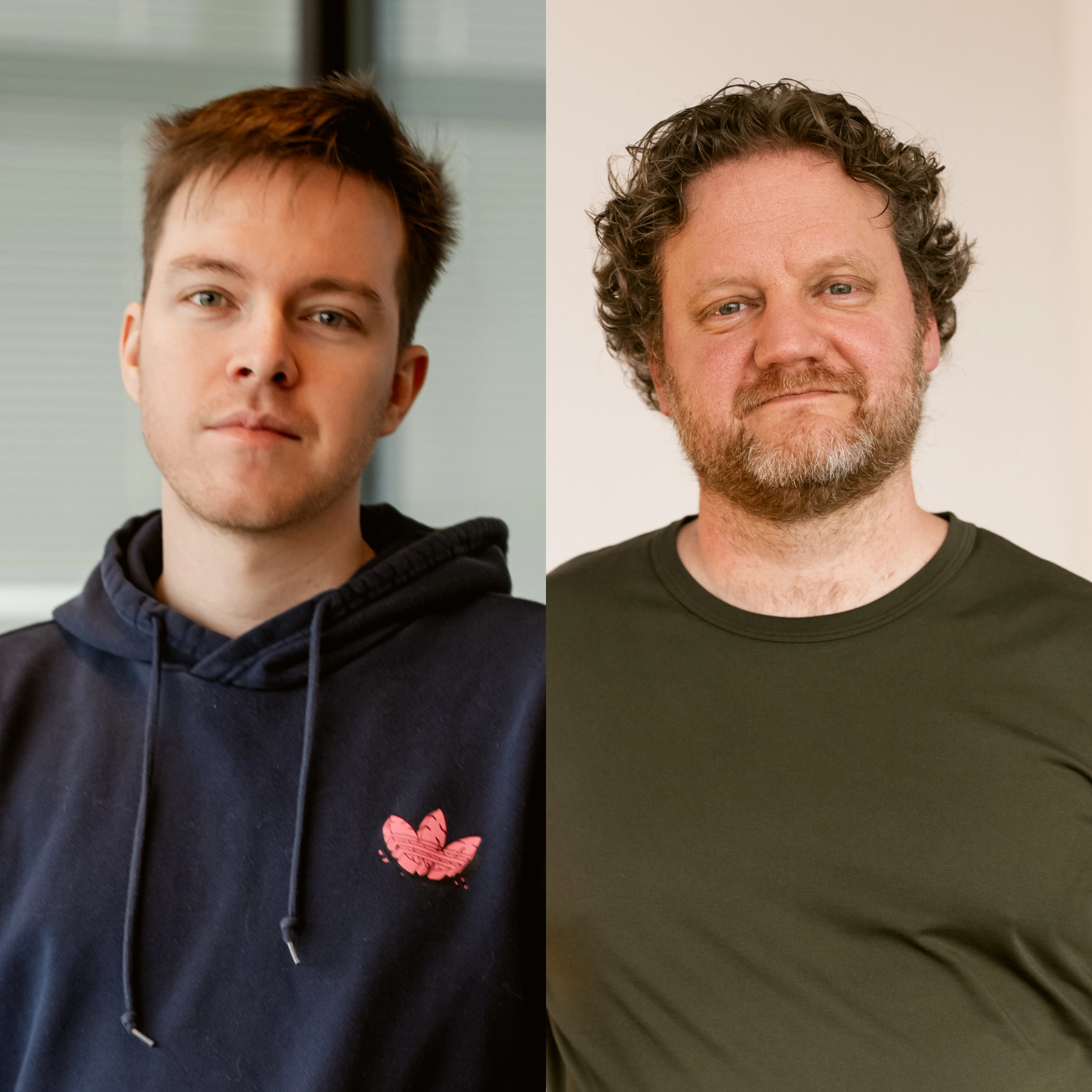
Sybren Geel & Daan Zonneveld
Creative Technologist & AI-Lead
26 May 2026, 7 minutes
Reading Google's Gemini Wave: What sticks, what doesn't. A Hypersolid read on Google's latest AI releases
Reader's note
This piece reflects an internal conversation between Daan Zonneveld (AI Lead) and Sybren Geel (Creative Technologist) at Hypersolid, edited for publication.

Last week Google released a stack of things at once: Gemini 3.5 Flash, Gemini Spark, Antigravity, Omni, a SynthID rollout, a pricing-model shift, and a renewed push into XR glasses.
As a technology company that uses these kinds of tools daily and ships them to clients, we wanted to react before the marketing dust settles. Two of our own Daan Zonneveld, AI Lead, and Sybren Geel, Creative Technologist, sat down to go through the releases. They give their view on what they believe is interesting and what they see as the overall strategy behind the releases.
What follows is their read.
Gemini 3.5 Flash; optimized for speed
The headline release is Gemini 3.5 Flash. Speed is the story Google is leading with, and on that axis it delivers. Real-time responsiveness opens up a class of use cases (live widgets, low-latency conversational layers, in-product assistants) that simply weren't feasible before. According to Sybren, that performance profile comes with trade-offs, particularly in more reasoning-intensive tasks.
Sybren Geel, Creative Technologist Hypersolid
Daan's caveat is to be careful when comparing. Google is positioning Flash 3.5 against its own previous Pro model and on the headline benchmark it wins by a hair. But pick the right reference point and the picture changes.

Google I/O’s headline release is Gemini 3.5 Flash
Daan Zonneveld, AI Lead Hypersolid
The trap with launch-day benchmarks is that they reduce a model to one number. Beating the previous generation by 0.1% on a single metric doesn't mean much if the new model needed more steps and more tokens to get there. As Daan put it: "If the previous model was pretty bad, beating it isn't a high bar."
Take-away: Flash 3.5 is genuinely useful for high-volume, latency-sensitive tasks where "fast and good enough" beats "slow and brilliant." The strongest fit for reasoning-heavy tasks will become clearer once Gemini 3.5 Pro is available.
The story underneath the model: Google's hardware vertical
In our view, the most strategically interesting piece of this release isn't the model. It's the silicon underneath it.
The default inside data centres has always been Nvidia. They make the GPUs that everything runs on. Google has spent years building an alternative: their own Tensor Processing Units (TPUs), designed and manufactured in-house, with a recent deal with Broadcom to extend the chip programme further. Anthropic is already using Google's chips. Amazon, xAI, and a few others are heading in the same direction as Google, working on their own hardware.
Sybren Geel, Creative Technologist Hypersolid
For a layperson, the cleanest analogy is Formula 1. Since this season, Red Bull Racing doesn't just build their own car; they have now moved into building their own engine. Although it is very challenging for them to develop an engine as a soft drinks company, it gives them space to optimize the way the car and engine are working together. Before this season, Red Bull had to adjust their car to the engine being delivered by a manufacturer like Honda or Renault. Owning the chain is what lets you optimize across it instead of within it.
This is also why Gemini 3.5 Flash can be run the way it can the speed isn't a model trick. It's a hardware advantage that compounds with every release. "This is the first release that really shows how fast they've become," says Sybren. "And the gap from here will probably widen, not close."
SynthID: the watermark that survives
A quieter release, but one that matters for anyone working in or around creative production: Google has shipped SynthID broadly, and OpenAI and other providers are signing on to implement it too.
SynthID is an invisible fingerprint embedded in AI-generated images. The model that generated it knows the watermark is there; detection tooling can recognize it; the human eye can't see it. The interesting property is robustness: a SynthID watermark is designed to survive transformations, cropping, recompression, mild edits, and still be detectable.
For any creative company, this is the start of a real provenance layer. Once cross-vendor implementation lands properly, the question “Is this image AI-generated?" moves from "We have no idea" to "The watermark is still there, and it says yes." That changes editorial workflows, brand-safety reviews, and how clients can responsibly use generative imagery in campaigns.
Gemini Omni: from video model to world model
The technical highlight of the release, for Sybren, is Omni and specifically the shift it represents.
Previous video models were trained on video clips. You'd describe what you wanted; the model would synthesize a video that looked plausible based on what it had seen before. It had no real concept of gravity, or wind, or water but only of how those things had appeared in clips.
Omni doesn't literally get "world principles" handed to it as rules. It still learns from data. The shift is in scale, architecture, and multimodal grounding, which together let the model build up what Google calls an intuitive understanding of physics during training. The same model takes anything as input for instance text, an image, a video and the practical upshot is the same: it reasons about what should physically happen next, instead of interpolating between clips it has seen before.
Sybren Geel, Creative Technologist Hypersolid

Google introduced Gemini Omni, where Gemini’s ability to reason meets the ability to create
Daan's analogy: where you used to have a 4×4 model, a regular car model, and an F1 model. Separate things for separate jobs. Omni is one car that understands how driving works and can do all of it. Text, video, audio used to be separate model families; Omni collapses them into one.
For clients, the immediate question is "What does this mean for video production?"
If you produce video at any scale like campaigns, social, e-commerce, internal communications, the cost curve just changed direction. Production cost is no longer dominated by location, crew, and editing time. It's increasingly dominated by what you can describe and how good the model is at imagining it. The companies that figure out a credible workflow on top of Omni-class models first will move fast; the ones that wait will be playing catch-up.
The pricing shift: pay-per-use is becoming the industry signal
A less glamorous release, but one Daan flagged as strategically important: Google is moving its consumer-AI products to a pay-per-use model. You no longer get X requests per day. You pay for what you actually consume, plus a margin.
Daan Zonneveld, AI Lead Hypersolid
The previous model was effectively a subsidy. You'd pay €2 for 100 requests a day; if your actual consumption was worth €5–10 of model cost, the provider absorbed it. That's not a sustainable business model. Cursor, Anthropic, and now Google are all converging on the same answer: usage-based pricing with margin, and a credit wallet for predictability.
For clients, this is a planning problem more than a product one. AI budgets need to look more like cloud budgets (variable, observable), with cost controls in place from day one instead of like SaaS budgets with a fixed per-seat fee. The cost circuit breakers we wire into agent fleets aren't a defensive afterthought; they're going to be standard.
Gemini Spark: easy to use, easy to get locked in
Gemini Spark is Google's answer to OpenClaw routines. A 24/7 personal agent, accessible to anyone on the highest subscription tier (US-only for now). Under the hood it's an open setup: you click an agent in the Gemini UI and it just runs, using tools through the standard MCP interface.
The accessibility story is real. What used to take a developer to wire up is now a click. The lower the threshold, the more people will actually use it.
Sybren Geel, Creative Technologist Hypersolid
That last clause is the catch. Spark is most useful inside the Google ecosystem like Gmail, Drive, Calendar, Workspace, because that's where the data and the integrations are. Google is also the only major player that owns a complete consumer ecosystem at this depth. That's a strong ecosystem advantage.
Our takeaway: For consumers, Spark is going to be excellent and very sticky. For enterprises, the "best of breed" instinct still applies: a single provider's complete ecosystem is convenient and locked-in by definition. If your AI strategy depends on being able to swap models, integrate with multiple providers, and not have your prompts and context become tied to a single ecosystem, an entirely Google-native stack is a strategic decision, not a default.
Android XR: maybe glasses finally work this time
Google also pushed forward on smart glasses. Android XR is the OS; Samsung and Gentle Monster are the hardware partners; the bet is that this time the form factor sticks.
The honest question is why now, given that Google Glass, the Metaverse, 3D TVs, and a long list of similar attempts have already failed. The answer, according to Sybren, is AI-first design.
Sybren Geel, Creative Technologist Hypersolid
Technology is also better. Sharper displays, longer battery life, more capable on-device inference. And the licensing model is a sharper choice than Meta's: Google is doing what they did with Android phones: ship the OS, partner on the hardware, maybe ship a Pixel-branded reference device themselves.
Meta has sold seven million Ray-Ban Metas worldwide. That's not a hit, but it's not a flop either. The display-equipped variant is currently US-only, with the SDK now opening up so developers can start building things to render on it.
That said, Daan and Sybren both think it's still early.
Our take-away: This pattern looks a lot like 3D TVs: manufacturers desperate to push the next form factor into the consumer market, consumers not yet sure they want it. The use case that broke 3D wasn't consumer, it was business. Google Glass eventually found a real home in factories, warehouses, and field-service work where a heads-up AI assistant pays for itself in minutes.
Hypersolid is running a proof-of-concept with PostNL on exactly this: smart-glasses-assisted workflows for parcel-delivery staff. If every parcel-delivery worker globally could do their job a few percent more efficiently with AI-assisted glasses, that's a use case with real numbers behind it. "Early adopter and technies walking around with one” — to borrow Sybren's framing, is not yet a use case.
What we take from this wave
A few things stand out across the whole release.
The hardware story is a strategic one. Faster, cheaper, more efficient inference is going to compound over the next twelve months, and Google's vertical integration is the single biggest reason to take their roadmap seriously, regardless of whether Flash 3.5 is the model you want to build on today.
The world-model shift in Omni is a technical story. It's going to reshape video and audio production economics in ways we're still catching up with.
The pricing shift is the operational story. Pay-per-use is the industry signal, not just a Google move. Your AI cost model needs to look more like a cloud than SaaS.
The ecosystem story, Spark, the Workspace integrations, Android XR, is a strategic-risk story. Google's complete ecosystem is a real advantage for consumers and a real lock-in vector for enterprises. Both can be true at once.
And on glasses: cautious yes for enterprise and field-service, cautious no for consumer, at least until the use case is more than founder-types on a talk show
If you're thinking about how any of these lands inside your organization: what to adopt, what to wait on, what to avoid. Reach out to us below as that's the conversation, we'd be glad to have.
Contact us and let's get started