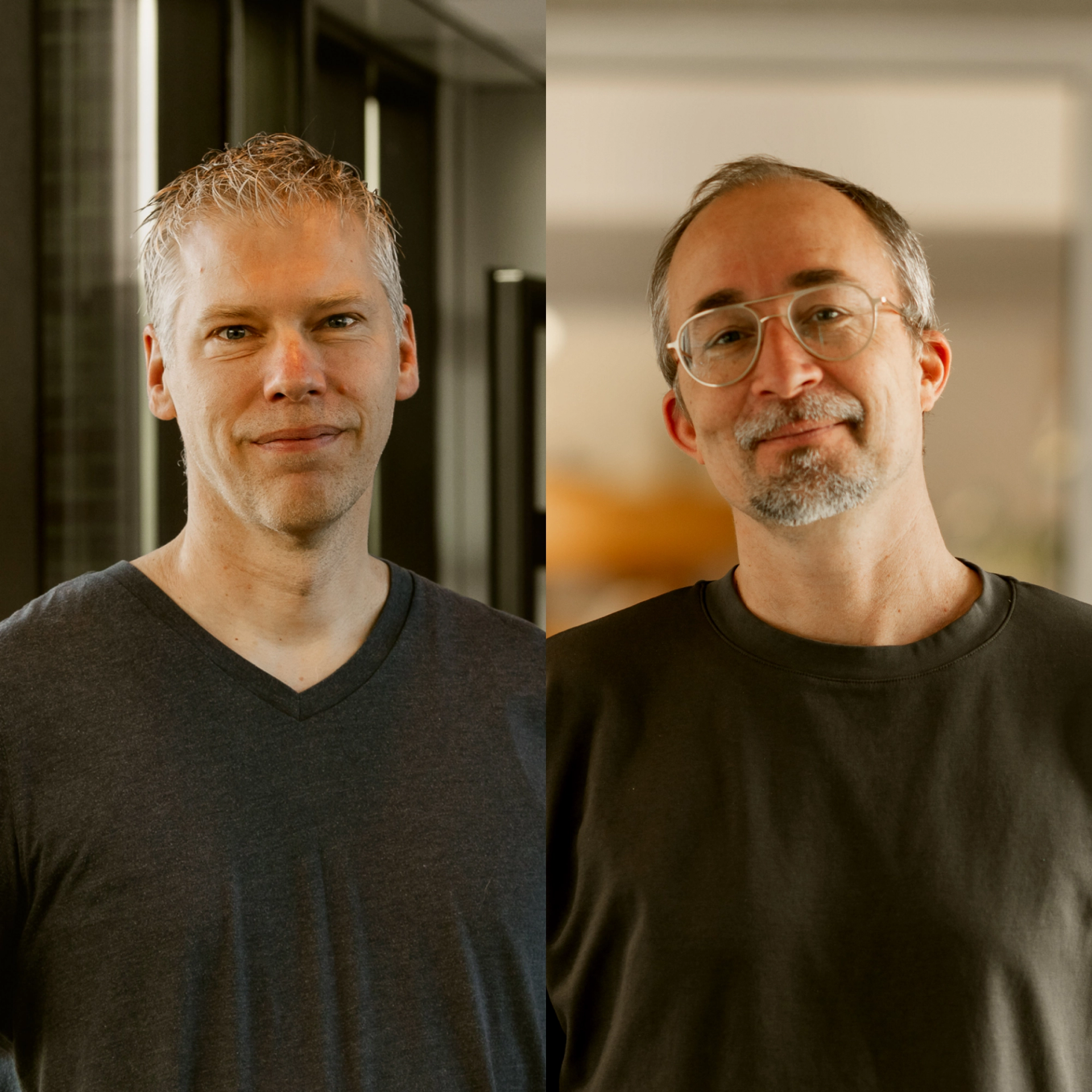
Pieter Dubelaar & David Vogel
Solution Architect & Executive Experience Director
20 Jan 2026, 6 minutes
What’s coming in 2026 for Digital Platforms and Intelligent Experience
Introduction
As we look ahead to 2026, it’s clear that the next phase of digital transformation is taking shape. Digital platforms and customer experiences are undergoing a structural reset. The main change in both platform development and experience design is that generative AI is no longer an experimental layer. It is becoming a structural part of how people search, decide, configure, and interact with products and services.
In this article, two Hypersolid leaders share their perspectives on what this shift means in practice: Pieter Dubelaar, Solution Architecture Lead, explores how digital platforms must evolve to remain reliable, authoritative, and useful in an AI-driven landscape. David Vogel, Executive Experience Director, looks at how Intelligent Experience will push AI beyond chat interfaces and into richer, more adaptive experiences.
Together, these perspectives sketch what is coming in 2026, and how platforms and experiences are beginning to converge.

Pieter Dubelaar, Solution Architect at Hypersolid
Interview
Digital platforms as authoritative systems in 2026, by Pieter Dubelaar
A new kind of frustration has been feeding the AI-skeptic part of my brain in 2025. When troubleshooting a device or piece of software, I instinctively turn to an AI assistant for help. The answers arrive instantly, but too often they reflect an earlier version of the product, which forces me to guess, search, and adapt.
This frustration reveals a deeper issue. AI’s strength lies in abstraction, yet that same abstraction breaks down when accuracy, versioning, and context matter. Because AI tools respond quickly and confidently, they rarely challenge whether the user is asking the right question, and important nuance gets lost along the way.
By 2026, this tension will force digital platforms to change in two important ways. Firstly, Generative Engine Optimization will evolve beyond credibility and attribution and move toward version-aware, time-sensitive knowledge. Standards will emerge that allow platforms to link information to specific product and software versions, and to clearly signal when information is outdated. Digital platforms will reclaim their role as authoritative sources of truth.
For example, this means we will move to a digital platform that acts as a single source of truth across the full lifecycle of a product. Instead of generic documentation, it provides version-aware and time-sensitive knowledge that AI systems can safely reference. This prevents outdated instructions from resurfacing and positions the platform as the authority behind every answer.
Intelligent assistance
Secondly, interaction patterns will shift from simple question-and-answer toward guided problem solving. Instead of responding immediately, AI systems will ask clarifying questions that help users articulate their needs more precisely. Digital platforms will feel less like databases and more like intelligent assistants that guide users toward the right outcome. For example, think of a support environment that starts with understanding rather than answers. The platform uses AI to establish context by asking about the exact product, configuration, and situation. Only then does it guide the user toward a solution, turning the platform into an active problem-solving system.
From platforms to experiences
All of this will lead to digital platforms that are more precise, contextual, and authoritative, and thereby unlocking a broader shift.
Platforms will stop behaving like static interfaces and start behaving like systems that respond to intent, rather than predefined flows. This is where the evolution of digital platforms naturally meets the rise of Intelligent Experience.

David Vogel, Executive Experience Director at Hypersolid
2026: the year of intelligent experience, by David Vogel
In February 2024, Hypersolid created the world’s first AI-powered virtual showroom for the Lotus Eletre, known as the Personal Showroom. Lotus’ first fully electric model after the brand relaunch was introduced through a digital experience that combined high-quality studio footage with real-time stitching and AI-powered answers to any question about the car.
The Personal Showroom demonstrates what becomes possible when AI moves beyond a chat interface and becomes the engine behind a responsive, adaptive experience. Rather than forcing users through predefined flows, the experience responded dynamically to user intent and curiosity.

Together with Lotus, we reinvented retail with the world's first AI powered car showroom
The project was built only a year and a half after the public launch of ChatGPT, at a time when tooling was limited to little more than a public API. Even today, AI is still primarily experienced through chat interfaces, which highlights how early this shift toward experience-led AI really is.
By 2026, this will begin to change. AI is increasingly used not as an interface, but as a foundational layer that powers bespoke experiences combining interface design, motion, sound, video, and even physical interaction.
To understand the significance of this shift, it helps to see AI as fundamentally different from previous technology waves. The web was a medium. E-commerce and social media were applications built on top of it. Mobile phones were hardware. AI operates across all of these layers simultaneously and enables entirely new ones.
Technology writer Kevin Kelly has compared AI to electricity. Electricity decentralized power by embedding it into countless machines rather than relying on a single engine. AI will do the same for intelligence, distributing it across tools, services, and products. This idea of distributed intelligence will fundamentally shape how experiences are designed and how systems behave.
As intelligence becomes embedded across touchpoints, experiences will feel less transactional and more adaptive. This marks the transition toward Intelligent Experience, where AI does not simply respond to users, but actively shapes how products and services behave.
Examples
To make it a little bit clearer, I will give you two examples.
The first example of Intelligent Experience is how search and discovery evolve in an AI-driven environment. Instead of relying on keywords and result lists, users explore brands and products through conversation, with the experience adapting in real time to intent, context, and curiosity. Intelligence becomes an integrated layer that shapes discovery rather than a separate search function.
Another example is product exploration and configuration. Rather than guiding users through fixed steps or static configurators, Intelligent Experience allows configuration to become an adaptive dialogue based on needs, behavior, and context. This mirrors how a knowledgeable human advisor would guide exploration, while remaining fully digital and scalable.
Hypersolid’s focus for 2026
For Hypersolid, the convergence of digital platforms and Intelligent Experience defines our focus for the year ahead. AI is becoming a structural layer in how platforms operate and how experiences are designed, and this shift shapes where we put our attention and energy.
At the core, our approach to building and delivering digital platforms remains unchanged: at Hypersolid we help ambitious organizations make a transformative impact at scale. We do this by delivering digital experience platforms that are hyper-engaging, built on a solid foundation of technology and data.
For 2026 specifically, it means we will focus on building platforms that are authoritative, precise, and trustworthy, while designing experiences that are adaptive and intelligent driven. The real opportunity lies in bringing these two together, so intelligence becomes something people can rely on and interact with naturally.
Let’s talk
This is an exciting moment for us. The tools are maturing, and the questions are becoming clearer. We are looking forward to exploring what comes next with our clients as digital platforms and Intelligent Experience continue to evolve.
If you are curious how these developments could shape your digital platforms or customer experience strategy, we would love to explore that with you. Feel free to get in touch.
Contact us and let's get started